By 2026, the touring landscape for electronic music has quietly but fundamentally changed.
Not through hype, but through structure.
For independent artists, the old model was blunt. Make noise online. Chase playlists. Email big agencies. Hope something sticks.
The new model is more surgical. It rewards artists who understand how scenes are actually organized, not how they appear on social media.
This is where data, not fame, becomes leverage.
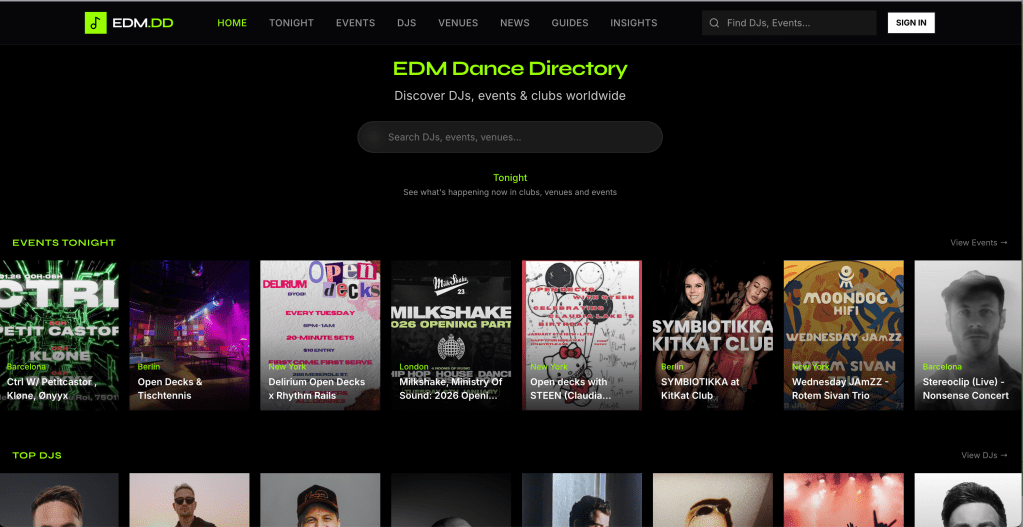
Platforms like EDM Dance Directory make it possible to approach touring not as a gamble, but as a system that can be studied, mapped, and entered deliberately.
Touring Is No Longer Global. It’s Territorial.
One of the biggest misconceptions artists still carry into 2026 is that touring is global by default.
In reality, touring has become regional, layered, and agency-specific.
Many DJs now operate with:
- one agency for Europe
- another for Asia
- sometimes a third for the Americas or niche territories
This fragmentation creates opportunity.
Instead of pitching global agencies like WME or CAA, independent artists can identify boutique or mid-tier agencies that already operate inside the exact genre and region they are targeting.
Hard techno in Eastern Europe.
Afro house in Southeast Asia.
Melodic techno in Southern Europe.
The goal is not representation.
The goal is adjacency.
By identifying which agents are responsible for artists one or two levels above your current position, you gain access to realistic support slots, warm introductions, and regional touring legs that are already funded and routed.
From “Any Venue” to the Right Room
Touring sustainably in 2026 is no longer about playing as many cities as possible.
It is about playing rooms that match your current gravity.
Over-sized venues kill momentum.
Under-sized rooms stall growth.
The shift toward 200–500 capacity clubs is not aesthetic. It is economic.
Using venue-level mapping, artists can identify:
- clubs that consistently book their sub-genre
- cities where that sound already has repeat attendance
- promoters and talent buyers who operate outside festival cycles
Instead of pitching abstract potential, artists can approach venues with local proof.
City-level engagement. Past attendance. Genre-specific demand.
Not “I’m touring Europe.”
But “I can move people in your room.”
The Support Slot Is the New Headline
For independent artists, support slots are no longer a stepping stone.
They are the strategy.
The most effective touring paths in 2026 come from micro-alignment. Artists slightly ahead of you in the same niche. Similar crowd psychology. Complementary energy, not competition.
By reverse-looking up those artists and identifying their booking agencies, independent DJs can pitch themselves not as unknown acts, but as perfect contextual openers.
This requires a shift in mindset.
The Electronic Press Kit is no longer about biography.
It is about fit.
Why your sound prepares the room.
Why your audience overlaps.
Why promoters benefit from continuity instead of contrast.
Human Performance as a Differentiator
As AI-generated music floods digital platforms, touring has become one of the few remaining undeniably human signals.
Promoters are not looking for perfection.
They are looking for presence.
Live and hybrid electronic acts, improvisational sets, hardware-driven performances. These elements signal risk, authenticity, and uniqueness. All qualities that algorithms cannot replicate.
Using structured directories, artists can identify agencies, labels, and venues that explicitly value live performance and experimentation.
In 2026, imperfection is not a weakness.
It is a booking asset.
Data That Actually Matters
Touring decisions are increasingly driven by specific signals, not total numbers.
Promoters care less about total followers and more about:
- repeat listeners in a city
- save-to-play ratios
- story views during local announcements
- ticket conversion history
When artists align their routing with high-growth regions already visible in structured data, such as emerging scenes in Thailand, Mexico, or secondary European cities, the pitch becomes collaborative rather than speculative.
You are not asking for a chance.
You are confirming demand.
What EDM Dance Directory Actually Is
EDM Dance Directory exists precisely for this type of thinking.
It is a global digital reference platform for electronic dance music culture.
As of January 2026, it functions as a structured, searchable map of the worldwide electronic music ecosystem.
Not trends. Not opinions. Structure.
The platform documents:
- global scenes by city and country
- artists and professionals organized by genre and activity
- venues as long-term cultural infrastructure
- events and festivals across regions
- a detailed genre taxonomy, from mainstream house and techno to niche styles like hard techno, psytrance, or speed garage
Unlike editorial platforms or ticketing apps, EDM Dance Directory is built as infrastructure.
A reference layer beneath the noise.
It does not replace platforms like Resident Advisor or Beatport.
It complements them by answering questions those platforms are not designed to answer.
Who This Is For
For industry professionals, the platform serves as a planning and research tool.
For artists, it becomes a way to understand how the system actually works.
For fans and travelers, it functions as a global yellow pages for electronic music.
The value is not volume traffic.
It is high-intent clarity.
Touring as System Literacy
The real shift in 2026 is not technological.
It is cognitive.
Artists who understand the structure of scenes, agencies, venues, and genres move faster with less friction. They stop shouting into the void and start entering conversations that are already happening.
Touring is no longer about being discovered.
It is about knowing where you belong next.
EDM Dance Directory does not promise success.
It offers something more durable.
Context. Structure. And a clearer map of the world you are trying to move through.