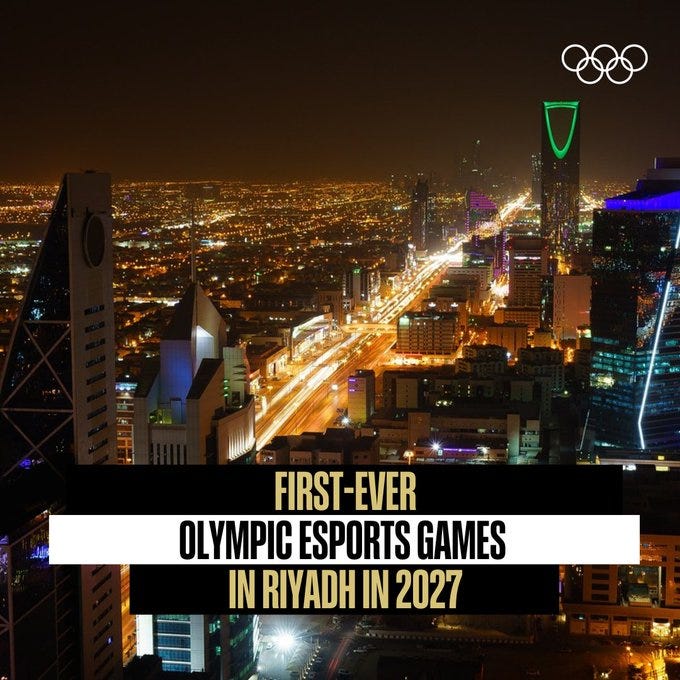
For many years, esports pioneers have fought to put competitive gaming on the global stage. What started in underground LAN parties and internet cafes has grown into a billion-dollar industry, watched by millions worldwide.
Now, the biggest stage of them all — the Olympics — is finally opening its doors to esports.
The inaugural Olympic Esports Games, originally planned for 2025, will now take place in 2027. While this recognition is a huge win for the industry, the road to this milestone has been anything but smooth.
Delays, publisher disputes, financial uncertainty, and Saudi Arabia’s controversial involvement raise serious questions.
So, is this a defining moment for esports, or is the Olympic movement struggling to understand what makes competitive gaming special? More importantly, do esports even need the Olympics?
Let’s break it down.
Subscribe for Exclusive Insights!
If you enjoy my articles on gaming, industry trends, and the future of play, why not get them delivered straight to you? Subscribe now: medium.com/@reinouttebrake/subscribe
Esports Finally Makes It to the Olympics — Why This Matters
For decades, competitive gaming has fought to be taken seriously. While traditional sports enthusiasts wrote esports off as “just kids playing video games,” the numbers told a different story.
- 20,000+ people attended the first in-person Olympic Esports Week in Singapore (2023).
- 250,000 players participated in the 2021 Olympic Virtual Series.
- The Saudi Public Investment Fund (PIF) has invested $38 billion into esports.
Esports is already bigger than many traditional sports, drawing higher viewership than some Olympic events. The Olympics stepping in validates what the industry already knows: gaming isn’t just the future — it’s happening now.
For the pioneers of esports, the ones who started as grassroots tournament organizers, pro players, and early investors, this is a moment of recognition. They built this industry, and now, the biggest sporting event in history is paying attention.
But is the Olympic Esports Games set up for success?
Read also: From Indie Hero to Industry Villain: Can Unity Win Back Game Developers?
Why Was It Delayed? The Real Story Behind the Postponement
The Olympic Esports Games were supposed to debut in 2025, but they’ve now been pushed to 2027. Why?
- Game publishers weren’t on board. The IOC failed to lock in deals with key game publishers in time.
- No game titles were confirmed. Even today, we still don’t know what esports will be played.
- Financial and logistical concerns. The Olympic Esports Games require a different business model than traditional Olympic events.
Simply put: esports doesn’t fit neatly into the Olympic structure. While traditional sports have national federations and clear regulatory bodies, esports is driven by game publishers who own the rights to their titles. If they don’t agree with the IOC’s terms, they won’t participate.
The delay isn’t just a scheduling issue — it’s a sign of the challenges esports faces in adapting to the Olympic framework.
Read also: Savvy Games Group: Saudi Arabia’s Bold Play to Dominate Gaming
Saudi Arabia’s Role: Investment or Takeover?
One of the biggest talking points? Saudi Arabia is hosting the first three Olympic Esports Games (2027, 2031, 2035).
This isn’t random. Saudi Arabia has invested $38 billion in gaming and esports through its Public Investment Fund (PIF), buying stakes in Electronic Arts, Nintendo, Nexon, Capcom, ESL FACEIT, and Hero Esports.
The IOC signed a 12-year deal with Saudi Arabia to host the Olympic Esports Games regularly.
But it’s not without controversy. The country’s human rights record, gender inequality, and laws criminalizing LGBTQ+ people have sparked backlash. Many critics argue that Saudi Arabia is using esports as a tool for “esportswashing”, trying to clean up its global image by investing in gaming.
On the other hand, Saudi Arabia is undeniably pouring money and resources into esports like no other country. Its backing could mean bigger prize pools, larger events, and more exposure for esports on a global stage.
But at what cost?
Read also: Overwolf: The Future of User-Generated Content in Gaming
What Games Will (and Won’t) Make the Cut?
One major issue: the IOC has a strict policy against violent games.
That means some of esports’ biggest titles — Call of Duty, Counter-Strike, Apex Legends, Rainbow Six Siege — probably won’t be included.
So, what’s left? Likely contenders include:
- MOBA games like League of Legends and Dota 2.
- Sports games like FIFA and NBA 2K.
- Racing simulators like Gran Turismo.
- Strategy games like Chess.com or StarCraft II.
This raises a big question: Will the Olympic Esports Games feel like real esports, or just a sanitized version for mainstream audiences? If the most popular competitive games aren’t there, will fans even care?
Do Esports Need the Olympics, or Does the Olympics Need Esports?
Esports already has massive standalone events that operate without the Olympic brand:
- The International (Dota 2) — prize pools exceeding $40 million.
- League of Legends Worlds — peak viewership of over 5 million.
- Valorant Champions Tour — global expansion with massive regional leagues.
Meanwhile, the Olympics is struggling to stay relevant with younger audiences. The inclusion of esports could be their way to attract Gen Z viewers who are more likely to watch Twitch than traditional TV.
So, who benefits more? Esports already thrives without the Olympics. But for the IOC, this is a chance to modernize and pull in a whole new generation of fans.
The real test will be whether the Olympic Esports Games actually add value to competitive gaming — or if it just becomes another bureaucratic event that players and fans ignore.
Read also: Winners and Losers in Gaming: Crytek and Unity Face Cuts While Remedy and Krafton Thrive
The Future: A New Era for Esports or a Failed Experiment?
If done right, the Olympic Esports Games could be a defining moment for gaming — a bridge between esports and mainstream sports. It could bring new sponsorships, investment, and legitimacy.
But if game publishers, players, and fans don’t buy in, it could be a one-and-done experiment that disappears after a few cycles.
One thing’s for sure: esports doesn’t need validation anymore. It’s already bigger than anyone could have predicted.
The Olympic Esports Games are a risk — but if esports has proven anything, it’s that risks can pay off. The real question is: will the Olympics play the game right?
Ralf Reichert: A Visionary Behind Olympic Esports
While the Olympic Esports Games are a collaborative effort, one name stands out: Ralf Reichert.
As the CEO of the Esports World Cup Foundation (EWCF), Reichert has been instrumental in shaping the vision of the first-ever Olympic Esports Games, ensuring that esports gets the recognition it deserves on a global stage.
For years, Reichert has been at the forefront of esports, from his leadership at ESL FACEIT Group (one of the world’s largest esports tournament organizers) to pushing for esports to be taken seriously by traditional sports institutions. Now, he’s spearheading a historic moment where competitive gaming is stepping onto the Olympic platform.
Reichert’s influence is not just about organizing tournaments. His efforts have been about bridging the gap between esports and traditional sports — something that many thought would never happen. By securing the partnership between IOC and EWCF, he has laid the groundwork for a sustainable, structured future for Olympic-level esports.
His role in aligning national esports ecosystems with global standards is critical. In a world where esports often operates in fragmented circuits, Reichert’s work brings legitimacy and structure to a rapidly growing industry.
The Olympic Esports Games wouldn’t be where they are today without him — and the next few years will determine whether this event becomes a defining moment for gaming history or just another missed opportunity.
2027 will be historic
Esports has come a long way, and its pioneers are finally seeing the industry recognized at the highest level. 2027 will be historic. But whether this moment elevates esports or just waters it down for mainstream audiences remains to be seen.
The Olympics may have just entered esports, but esports has been playing this game for decades. Now, it’s up to the IOC to prove that it understands what makes esports truly great.
What do you think? Will the Olympic Esports Games be a success, or is it missing the mark?
Stay Connected: Gaming Trends, Insights, and Your Take
Thank you for reading. Every day I look at the gaming industry, read up on things, and talk to industry people. In my Medium blogs, I try to give my readers and 1.5K followers a solid sense of trends, analysis, investments, and more in gaming. If you found this interesting, I’d appreciate it if you shared the article — but even more, I’d love to hear your thoughts in the comments! If you like to connect on Linkedin, feel free to send me an invite! And don’t forget to Subscribe Today! Get exclusive gaming industry insights from Reinout te Brake — a veteran with real data, deep expertise, & game-changing perspectives.