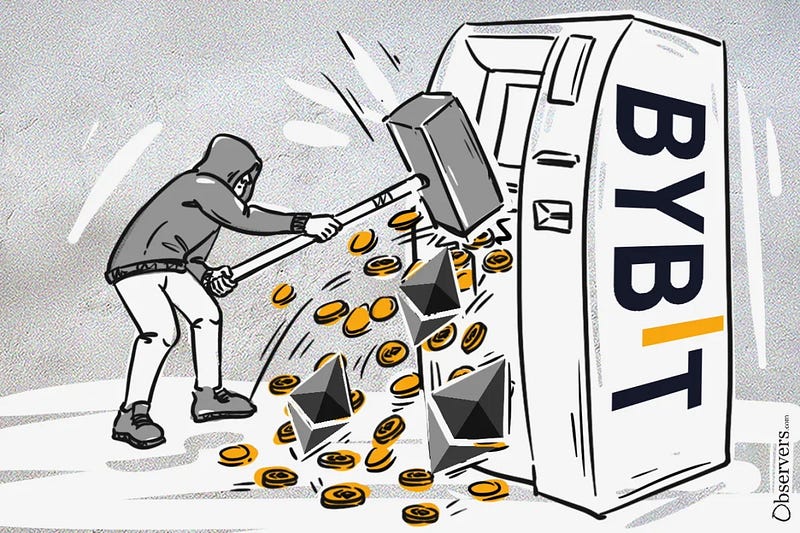
The Biggest Digital Bank Heist in History What happens when $1.5 billion disappears overnight?
It’s a question that rocked the crypto industry on February 21, 2025, when Bybit, one of the largest cryptocurrency exchanges, suffered the biggest hack in digital finance history.
In a single transaction, reports confirm that over 400,000 ETH, valued at around $1.5 billion, were taken during the breach from Bybit’s cold wallet.
In seconds, it vanished into an unknown address, triggering panic across the crypto world.
This wasn’t just another hack.
It was a calculated attack that exposed a fundamental weakness in how crypto exchanges handle security. Within hours, Bybit’s users flooded the platform fearing their assets were next.
Bybit announced it had successfully processed more than 580,000 withdrawals since the hack.
The event sent shockwaves across Web3 gaming, decentralized finance (DeFi), and the broader blockchain industry.
Bybit’s CEO, Ben Zhou, quickly reassured users: “All funds are backed 1:1. No customer will lose their assets.” But that wasn’t enough to stop the questions.
Who pulled off this heist? How did they do it? And what does this mean for the future of Web3?
Let’s break it down.
Subscribe Today! Get exclusive gaming industry insights from Reinout te Brake — a gaming veteran with real data, deep expertise, & game-changing perspectives. Join 1.3K+ others — subscribe now and stay ahead!
What Really Happened? The Anatomy of a $1.5 Billion Heist
How do you steal $1.5 billion in cryptocurrency from one of the world’s largest exchanges — without anyone noticing until it’s too late?
This wasn’t a simple phishing scam or a brute-force attack. It was a precision strike that exploited a key moment in Bybit’s security process: the transfer of funds from a cold wallet (offline storage) to a warm wallet (partially online storage used for daily transactions).
The Cold-to-Warm Wallet Weakness
Bybit, like most crypto exchanges, stores the majority of its assets in cold wallets — completely disconnected from the internet — to protect them from hackers. But to keep its platform liquid, Bybit periodically moves funds to warm wallets, which are more accessible for withdrawals and trading.
This is where things went wrong.
Routine Transfer Gone Wrong:
- On February 21, Bybit initiated a standard cold-to-warm wallet transfer, moving a portion of its Ethereum reserves to fund user withdrawals.
- This process requires a temporary connection between the offline cold wallet and the exchange’s infrastructure.
Attackers Strike at the Perfect Moment:
- Hackers intercepted this transfer process, gaining unauthorized access to the cold wallet’s private keys or transaction signing interface.
- They altered the transaction details in a way that wasn’t immediately visible to Bybit’s internal security systems.
The Money Vanishes Instantly:
- Instead of being sent to Bybit’s warm wallet, the 401,000 ETH was transferred to an unidentified blockchain address.
- Once the transaction was finalized, the funds were out of Bybit’s control — and on their way to being laundered.
By the time security teams noticed, the money was already moving through crypto mixers, privacy coins, and multiple wallets designed to obscure its final destination.
Who Was Behind It?
Blockchain forensic analysts, including teams from Arkham Intelligence, have been tracking the stolen funds. Their conclusion?
Blockchain analytics firms, such as Arkham Intelligence, have suggested potential involvement of North Korea’s Lazarus Group in the hack.
This state-backed cybercrime syndicate has a history of pulling off high-profile crypto heists, including:
- The $600 million hack of Axie Infinity’s Ronin Bridge in 2022.
- The $100 million Horizon Bridge attack in 2023.
- Multiple DeFi and exchange breaches, funding North Korea’s nuclear weapons program.
The pattern is familiar:
- Fast, large-scale theft.
- Sophisticated laundering tactics.
- Ties to blockchain obfuscation services.
Bybit’s stolen Ethereum is already being funneled through crypto mixers and exchanges with weak KYC regulations, making recovery incredibly difficult.
What Does This Mean for Crypto Security?
This wasn’t just a technical failure.
It was a fundamental flaw in how crypto exchanges operate.
- Cold wallets are only as secure as their transfer process. Every time a cold wallet is accessed, it introduces risk.
- Transaction validation must evolve. If a multi-billion-dollar exchange can be tricked into approving a fraudulent transaction, what does that say about the industry’s security standards?
- Lazarus Group isn’t slowing down. This isn’t their first attack — and it won’t be their last.
Bybit’s loss is crypto’s wake-up call.
Bybit insists that all user funds are safe. CEO Ben Zhou has guaranteed full coverage of losses and announced a bounty program for ethical hackers to help recover the stolen Ethereum.
But is this true security reform or just crisis PR?
Let’s take a closer look.
Bybit’s Response: Damage Control or Real Reform?
When $1.5 billion vanishes overnight, an exchange has two options: contain the panic or fix the problem.
Bybit’s CEO, Ben Zhou, moved fast to do both.
In a public statement, he assured users:
“All funds are backed 1:1. No customer will lose their assets.”
It was a bold claim. But was it enough?
How Bybit Contained the Panic
The first 24 hours after the hack were critical.
Bybit saw a massive surge in withdrawals — over 580,000 requests flooded the platform. Users were spooked, fearing a repeat of FTX, where an exchange collapsed overnight.
To prevent a bank run, Bybit immediately:
- Confirmed full solvency — Zhou publicly guaranteed that Bybit had the reserves to cover all user balances.
- Paused some withdrawals — not as a restriction, but to monitor unusual activity.
- Launched a security audit — to assess how attackers breached their cold wallet.
The message was clear: Bybit is still standing.
Can Bybit Actually Cover the Losses?
The exchange claims that customer assets are unaffected, meaning the loss will be absorbed by Bybit’s own reserves.
A few key questions remain:
- How much liquidity does Bybit really have? Covering $1.5 billion isn’t easy, even for a top-tier exchange.
- Will this impact trading fees or future investments? If Bybit absorbs the loss, it might have to increase fees or delay expansion.
- Will investors step in? If Bybit needs more capital, it could look for outside funding — but will investors trust them after this breach?
Right now, Bybit’s financials aren’t fully transparent. But if Zhou’s promise holds, they may avoid a long-term crisis.
The Bounty Program: A Real Plan or a PR Move?
Bybit also announced a 10% bounty program, offering ethical hackers a cut of the recovered funds.
In theory, this helps:
- Incentivizes blockchain experts to track the stolen Ethereum.
- Puts pressure on criminals who try to launder the funds.
- Buys Bybit time to improve its security.
But in reality, recovering stolen crypto is incredibly difficult.
Once Ethereum is moved through privacy-focused protocols and mixers, tracking it becomes nearly impossible. And even if some funds are found, forcing their return is another battle entirely.
So far, no recovered funds have been reported.
Security Overhaul: Will Anything Really Change?
Bybit has announced a series of security upgrades, including:
- Stronger multi-signature authentication for wallet transactions.
- A blacklisted wallet API — designed to track and block known hacker addresses.
- Internal security audits — to prevent insider threats.
These are important steps. But they raise a bigger question:
Why weren’t these protections in place before?
This hack wasn’t an unknown vulnerability. It was a well-known risk — one that other exchanges have already taken steps to mitigate.
Which brings us to the bigger issue:
Crypto’s Security Problem is Bigger Than Bybit
If a top-five exchange like Bybit can be exploited so easily, what does this mean for the rest of the industry?
Crypto has been built on a promise of decentralization and security. But in reality:
- Centralized exchanges still operate like traditional banks — with single points of failure.
- Even cold wallets aren’t as secure as once believed — because they still need to connect to warm wallets.
- Regulators are watching — expect tighter scrutiny and compliance rules after this event.
Bybit’s crisis isn’t just their own. It’s a warning sign for the entire space.
Bybit is standing for now. But Web3 gaming, decentralized finance (DeFi), and the broader crypto world are already feeling the impact.
The question is: Will this hack push Web3 toward decentralization — or prove that the industry is fundamentally broken?
That’s what we’ll explore next.
The Web3 Fallout: What This Means for Gaming and the Future of Crypto Security
Bybit’s $1.5 billion hack wasn’t just a problem for the exchange.
It sent shockwaves through the entire Web3 ecosystem — especially for gaming projects, which rely heavily on crypto liquidity and trust in digital asset security.
The big question now:
Is Web3 gaming built on a fragile foundation?
1. Trust in Centralized Platforms Is Fading
Web3 gaming projects depend on crypto exchanges like Bybit to onboard new users, enable token liquidity, and process in-game transactions.
This hack reinforces a growing fear — if an exchange holding billions in assets can be compromised, what does that mean for smaller platforms?
- Developers are rethinking their exchange partnerships. Projects that relied on Bybit for liquidity might now seek decentralized alternatives.
- Players are nervous about holding gaming tokens. If large exchanges aren’t safe, why should users trust in-game assets that depend on them?
- The narrative of ‘crypto security’ is weakening. Hacks like this highlight the contradiction between blockchain’s promise of security and the industry’s repeated failures to prevent attacks.
For Web3 gaming, this could accelerate a move toward true decentralization — or drive players away entirely.
2. The Financial Impact on Web3 Games
Web3 games don’t just rely on token sales — they rely on stable ecosystems where assets hold value.
Bybit’s hack introduces new risks that could impact in-game economies:
- Liquidity problems: Many Web3 games depend on crypto markets for buying, selling, and trading assets. If exchanges become unreliable, gaming economies lose a key financial pillar.
- Funding slowdowns: Investors already cautious about Web3 are now even more hesitant. Games relying on crypto funding rounds might face delays or lower valuations.
- Regulatory pressure: Governments are using major hacks like this as justification for tighter rules. Web3 gaming studios could be forced to comply with stricter KYC (Know Your Customer) and AML (Anti-Money Laundering) laws — potentially slowing adoption.
If play-to-earn and blockchain gaming were already struggling to maintain momentum, this event makes things even harder.
3. The Rise of Decentralized Alternatives?
This hack might finally push the industry to take decentralization seriously.
For years, Web3 promised a future without central gatekeepers, but in reality, most blockchain projects still depend on centralized exchanges like Bybit.
Now, projects are asking:
Should we move away from centralized exchanges entirely?
The alternatives:
- Decentralized exchanges (DEXs): More gaming projects might shift liquidity to decentralized platforms like Uniswap or dYdX, where users control their own assets.
- Self-custody for in-game assets: Games might start encouraging users to store NFTs and tokens in personal wallets, rather than relying on exchange accounts.
- Stronger security measures: Some Web3 games may require extra transaction verification steps to prevent exploits affecting their ecosystems.
The challenge?
Decentralization comes with its own risks, including liquidity constraints, user friction, and the inability to reverse fraudulent transactions.
This means Web3 gaming needs a balance — strong security without sacrificing usability.
4. Is This the Tipping Point for Crypto Security?
Bybit’s hack doesn’t just expose a weakness in one exchange — it exposes a larger vulnerability across the crypto industry.
And the consequences go beyond gaming:
- More regulatory scrutiny: Expect governments to use this hack to justify stricter crypto laws — especially in the US, EU, and Dubai (where Bybit is based).
- Increased investor skepticism: The market is already cautious about Web3. Another billion-dollar breach makes mainstream capital even harder to secure.
- Security as a new competitive advantage: Exchanges and gaming platforms will need to prove they can prevent attacks — or risk losing users to safer alternatives.
The industry can’t afford to ignore this moment.
The Bybit hack isn’t just another crypto incident — it’s a turning point.
The Future of Web3 After Bybit
This wasn’t a random exploit. It was a targeted attack that hit crypto at its core — showing that even the biggest platforms aren’t immune to vulnerabilities.
The question is: What happens next?
Crypto leaders now face two paths:
- Continue business as usual — pretend this was an isolated event, patch things up, and wait for the next crisis.
- Finally take security seriously — build real protections, rethink how exchanges operate, and rebuild trust in the ecosystem.
The choice they make will define the future of Web3, gaming, and decentralized finance.
One thing is certain:
Crypto security is no longer optional. It’s the only thing that matters now.
The gaming industry is changing fast. Are you keeping up?
Every day, I track gaming trends, analyze market shifts, and talk to industry leaders. My goal? To give you real insights — data-driven, strategic, and ahead of the curve.
If you found this piece valuable, I’d love to hear your thoughts in the comments.
But, Tap the clap 👏 button 50 times or more if you enjoyed my story! It would help me to get more visibility for my article.
And if you want more, check out my curated reading list of must-read articles on gaming.
Want to stay ahead of the game? Follow me on LinkedIn for deep insights and industry analysis, or subscribe to our newsletter.