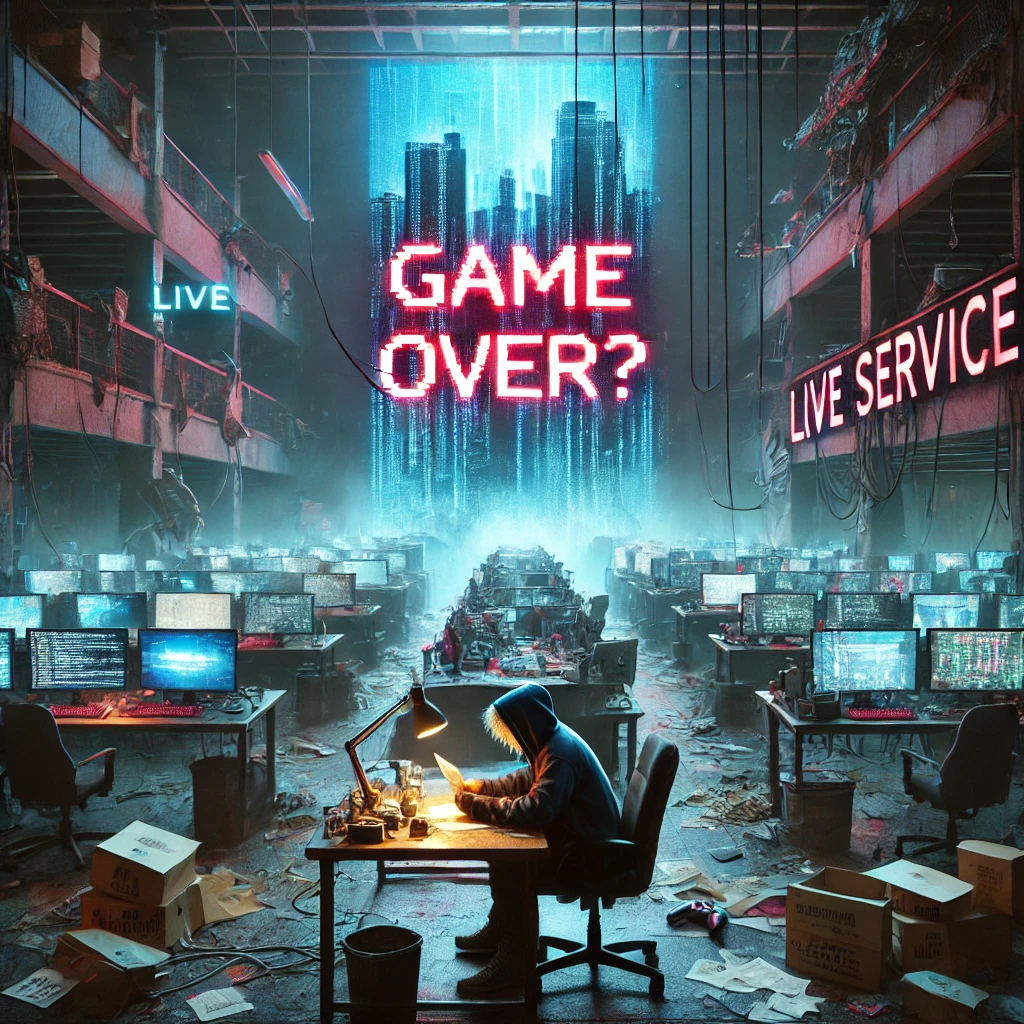
The video game industry is unraveling—layoffs, failing blockbusters, and collapsing studios are no longer isolated incidents, but signs of a much bigger crisis
A bit of history: In 1983, the video game industry collapsed. What was once a booming market fell apart almost overnight, with major publishers shutting down, console sales plummeting, and an oversaturated market drowning in low-quality games. The industry took years to recover.
Fast forward to 2024, and the warning signs are strikingly similar.
- Over 10,000 game developers lost their jobs in 2023, with layoffs rising by 40% in 2024.
- Major publishers like Microsoft, Sony, and EA are canceling projects as development costs soar.
- Blockbuster games aren’t selling like they used to, forcing studios into desperate monetization tactics.
- Players are rejecting live-service games and microtransactions, signaling a shift in consumer expectations.
For years, gaming felt like an unstoppable force, with record-breaking revenues and billion-dollar acquisitions. Now, the cracks are impossible to ignore.
So, what’s really happening? Is this just a temporary market correction, or is gaming on the edge of another industry-wide collapse?
This investigation dives into the financial struggles, workforce upheaval, and shifting player sentiment that are reshaping the gaming landscape.
Are we witnessing a painful but necessary evolution—or the start of a full-blown crisis?
I. Financial Struggles: The Economic Warning Signs
For decades, the gaming industry operated under the assumption of infinite growth—bigger budgets, more studios, and ever-expanding revenues. But in 2024, that assumption is unraveling.
The numbers tell a clear story:
- The U.S. gaming market shrank for the first time in years, contracting by 1% to $58.7 billion in 2024.
- Investor confidence is plummeting, with major gaming stocks seeing double-digit declines in early 2024.
- AAA game budgets have ballooned, now routinely exceeding $200M–$300M, making profitability harder than ever.
- Mass layoffs and studio closures are accelerating—more than 10,000 developers were laid off in 2023, and 2024 is already 40% worse.
Gaming, once a financial juggernaut, is showing major signs of economic instability. Let’s break down why.
1. The Blockbuster Model is Cracking
For years, the gaming industry’s business model relied on high-budget blockbusters—games that took five to seven years to develop, cost hundreds of millions, and needed to sell millions of copies instantly to turn a profit.
The problem? That strategy is no longer sustainable.
High-risk, high-reward has turned into high-risk, no guarantee. If a single game underperforms, it can wipe out an entire studio.
Recent examples of blockbuster struggles:
- Forspoken (Square Enix) – Failed to meet expectations, contributing to a $2 billion loss in market value.
- Suicide Squad: Kill the Justice League (Warner Bros) – Overly monetized, poorly received, struggling to retain players.
- Battlefield 2042 (EA) – Hyped as a major live-service hit, but engagement tanked, forcing EA to rethink its strategy.
Publishers now face an impossible dilemma:
Do they keep pumping $300M into each game, hoping for a hit? Or do they scale back, risking lower profits?
2. Layoffs & Studio Closures: The Human Cost of Industry Instability
While executives search for solutions, developers are paying the price.
Gaming layoffs in 2023–2024:
- Microsoft laid off 2,500 employees across its gaming divisions—including teams at Activision Blizzard, just months after its $68.7 billion acquisition.
- Riot Games, Ubisoft, and EA all downsized entire divisions, citing rising costs and uncertain revenue streams.
- Indie studios are shutting down at an alarming rate, unable to compete with skyrocketing development costs.
For many developers, job security is a thing of the past. Studios ramp up hiring during big projects, only to lay off staff once the game ships. This cycle of boom-and-bust employment is creating widespread instability, draining the industry of talent.
Why This Matters:
- Creative stagnation: Layoffs mean fewer risks, more sequels, and fewer fresh ideas in gaming.
- Brain drain: Developers are leaving the industry for safer jobs in tech, film, or AI.
- Player impact: Fewer staff means longer development cycles, more delays, and lower-quality games.
Gaming companies need a new strategy. The blockbuster model is failing, developers are burning out, and costs are out of control.
The question is: What happens next?
II. Player Backlash: The Growing Revolt Against Game Companies
The gaming industry isn’t just facing financial struggles—it’s also losing the trust of its most valuable asset: the players.
For years, major publishers bet big on live-service games, microtransactions, and battle passes, assuming players would keep spending. But in 2024, the tide is turning. Gamers are rejecting exploitative monetization, unfinished games, and corporate greed—and their frustration is reshaping the industry.
Let’s break down why players are walking away from gaming’s biggest companies.
1. The Death of Live-Service Games?
Live-service gaming—where companies release a game as a constantly updated, online-only experience—was once considered the future. But in 2024, the model is collapsing.
Live-service flops in 2024:
- Suicide Squad: Kill the Justice League (Warner Bros) – Pitched as a major live-service title, players abandoned it at launch due to predatory microtransactions and forced online play.
- Battlefield 2042 (EA) – Designed to be a long-term live-service game, but player engagement never recovered from its disastrous launch.
- XDefiant (Ubisoft) – Originally marketed as a Call of Duty competitor, delays and poor marketing caused its player base to disappear before release.
Why Players Are Rejecting Live-Service Games:
- Overpriced microtransactions – Battle passes, cosmetics, and pay-to-win mechanics are turning players away.
- Fatigue from constant updates – Gamers don’t want to commit to a game that feels like a second job.
- Too many failures – Players have been burned by unfinished or abandoned live-service titles too many times.
What’s changing?
Gamers are shifting back to premium, single-player experiences—games they can buy once and fully enjoy without constant monetization.
2. Unfinished Games & the Trust Crisis
In the past, preordering a game was a sign of excitement. Today? It’s a gamble.
More and more games are launching unfinished, forcing players to wait months for patches before they’re playable.
Recent broken game launches:
- Cyberpunk 2077 (CD Projekt Red) – Launched in 2020 as a disaster, only fully fixed in 2023.
- The Day Before (2023) – A hyped survival MMO that turned out to be a scam, removed from Steam within weeks.
- Skull and Bones (2024) – Ubisoft’s pirate game, in development for over a decade, launched to mixed reviews and a dwindling player base.
The consequences of unfinished games:
- Players no longer trust pre-orders – Many refuse to buy games at launch, waiting for fixes or price drops.
- Refund demands are skyrocketing – Steam offers flexible refunds, but PlayStation and Xbox face backlash for restrictive policies.
- Indie games are gaining ground – Players are shifting to smaller studios that focus on quality over rushed releases.
One frustrated gamer put it bluntly:
“I’m tired of paying $70 for a game that isn’t finished. I’ll just wait for a Steam sale.”
The trust gap between publishers and players has never been wider—and it’s only getting worse.
3. The Digital Ownership Problem: Do You Really Own Your Games?
The shift from physical to digital games has made buying games easier than ever. But there’s a growing problem—players are realizing that they don’t actually own what they pay for.
The decline of physical games:
- Less than 5% of all games sold in 2024 are physical copies.
- Major publishers are pushing digital exclusivity to control pricing and prevent resales.
Why this is worrying players:
- Nintendo shut down its Wii U and 3DS digital stores, permanently removing hundreds of games from purchase.
- Sony tried to remove PlayStation 3 digital purchases, but player backlash forced them to reverse the decision.
- PC gamers prefer DRM-free stores like GOG, where they can truly own their purchases.
Why This Matters:
The industry is moving toward a digital-only future—but players want control over their purchases. If major publishers don’t adapt, they risk pushing even more players away.
What Happens Next?
The message from players is clear:
- No more broken games.
- No more endless microtransactions.
- No more digital restrictions.
Gaming is at a turning point—and companies that ignore these shifts may not survive the coming years.
III. Can the Industry Adapt Before It’s Too Late?
The video game industry is standing at a crossroads. On one side, it’s facing financial instability, mass layoffs, and declining player trust. On the other, it has a chance to reinvent itself before another crash happens.
So, what needs to change? Can gaming evolve before it’s too late?
Let’s examine the three key areas where the industry must adapt—or risk collapsing under its own weight.
1. The End of $300M Blockbusters? AAA Development in Crisis
For years, publishers believed that bigger budgets meant bigger success. But as AAA game budgets hit $300 million and beyond, that strategy is backfiring.
Why AAA Development is No Longer Sustainable:
- Longer development cycles – Big games take 5–7 years to develop, delaying revenue streams.
- Unrealistic sales targets – If a game doesn’t sell 10+ million copies immediately, it’s considered a failure.
- Sequel and remake fatigue – Publishers prioritize safe bets over innovation, leading to stagnation.
The Fallout:
- Ubisoft has canceled multiple unannounced projects, citing financial concerns.
- Square Enix lost over $2 billion in market value after Forspoken and Final Fantasy XVI underperformed.
- Microsoft’s Game Pass model is struggling to turn a profit, as expensive exclusives fail to drive sustainable revenue.
What Needs to Change?
Instead of sinking hundreds of millions into a handful of blockbusters, publishers need to:
✅ Embrace mid-sized budgets – Focus on games in the $50M–$100M range, balancing quality and financial risk.
✅ Speed up development cycles – Reduce reliance on 6-year dev timelines.
✅ Encourage fresh ideas – Take risks on new IPs, not just sequels and remakes.
The gaming industry must break free from the “go big or go home” mentality—or risk losing everything.
2. The Rise of Mid-Sized & Indie Studios
While AAA publishers struggle, independent and mid-sized studios are thriving.
Why Smaller Games Are Winning:
✅ Lower costs – Indie teams can create high-quality games for a fraction of AAA budgets.
✅ Faster development cycles – Games take 1–3 years to complete, not 7+.
✅ Stronger player trust – Gamers are turning to indies for quality, creativity, and polished releases.
Recent Indie & Mid-Sized Success Stories:
- Baldur’s Gate 3 (Larian Studios) – Outperformed most AAA games in 2023, proving players value depth over big-budget spectacle.
- Dave the Diver (Mintrocket) – An indie title that became a massive commercial success without predatory monetization.
- Lies of P (Neowiz) – A Soulslike game from a mid-sized studio that challenged AAA competitors.
The Shift:
- Investors are shifting focus to mid-budget, high-quality games.
- Gamers are supporting indie studios more than ever.
- Even subscription services like Game Pass are investing in smaller games as AAA exclusives become unsustainable.
This mirrors the industry shift after the 1983 crash—when gaming recovered by embracing smaller, innovative projects.
3. Can Subscription Gaming Save the Industry?
With traditional game sales declining, many believe subscription models (like Xbox Game Pass, PlayStation Plus, and GeForce Now) could be gaming’s future.
Why Subscription Gaming Could Work:
✅ Steady revenue streams – Instead of relying on one-off sales, publishers get consistent income.
✅ Encourages experimentation – Developers can create unique games without worrying about high launch sales.
✅ More player-friendly – Gamers get access to hundreds of games for a monthly fee instead of paying $70 per game.
The Challenges:
- Microsoft reported Game Pass growth is slowing, showing the model may have a ceiling.
- AAA publishers are hesitant, as they rely on high initial game sales.
- The “Netflix problem” – If games get removed from the service, players may feel like they don’t own anything.
What Needs to Happen?
✅ Balance subscriptions with traditional sales – Not all games fit into a “Netflix-style” model.
✅ Ensure long-term access – Players need guarantees that their purchased digital games won’t disappear.
✅ Support developers fairly – Subscription revenue must benefit creators, not just platform holders.
While subscriptions won’t replace game sales entirely, they can be part of the solution—if done right.
IV. Will the Industry Collapse or Evolve?
The gaming industry is at a make-or-break moment.
- If publishers continue chasing unsustainable blockbusters, relying on layoffs, and ignoring player demands, the industry risks another major crash.
- If gaming embraces smaller budgets, player-friendly business models, and balanced subscription models, it can recover and evolve.
- The next 12–24 months will determine which path gaming takes.
The Bigger Picture: When Isolated Events Reveal an Industry-Wide Crisis instance:
In recent times, you’ve likely encountered various reports detailing layoffs, studio closures, and project cancellations within the gaming industry. Individually, these articles might appear as isolated incidents. However, when viewed collectively, they reveal a concerning pattern that underscores the industry’s current challenges.
- Crytek’s Financial Struggles: Crytek paused development on “Crysis 4” and laid off 15% of its staff due to challenging market conditions.
- Ubisoft’s Studio Closures: Ubisoft announced the closure of its Leamington Spa studio, resulting in 185 staff layoffs as part of ongoing cost-cutting measures.
- Electronic Arts’ Restructuring: EA laid off 6% of its workforce, approximately 775 employees, and canceled several projects, including a first-person shooter set in the Star Wars universe.
- Don’t Nod’s Workforce Reduction: The French studio Don’t Nod faced a strike after announcing a plan that threatened up to 69 positions, about 20% of its workforce, due to underperformance of recent launches.
- NetEase’s Global Cutbacks: NetEase implemented significant layoffs, including at its Marvel Rivals development studio in Seattle, and is considering canceling the game to avoid licensing fees.
- Netflix’s Shift in Gaming Strategy: Netflix’s gaming division faced layoffs, canceled projects, and studio closures as it shifted focus to narrative games based on its properties, leading to concerns about a decline in originality.
- Studio Closures and Project Cancellations: Warner Bros Discovery recently shut down three of its video game development studios—Player First Games, Warner Bros. Games San Diego, and Monolith Productions—halting development on Monolith’s “Wonder Woman” game.
- Layoffs Amid Strategic Shifts: BioWare laid off approximately two dozen employees as it shifts focus to the next Mass Effect game, following the underperformance of “Dragon Age: The Veilguard.”
- Financial Struggles Leading to Administration: Drop Bear Bytes, an Australian video game company, entered voluntary administration despite some success with its debut game, “Broken Roads,” highlighting the financial strains even smaller studios face.
- And the list goes on with more and more articles.
These developments, when pieced together, paint a broader picture of an industry grappling with economic pressures, shifting consumer preferences, and the need for adaptation. Recognizing these interconnected challenges is crucial for understanding the future trajectory of the gaming world.
What do you think? Is gaming heading for another crash, or will the industry adapt in time? Let’s discuss in the comments.
Hope you enjoyed to article. If you think others should know about this, do share it with them!