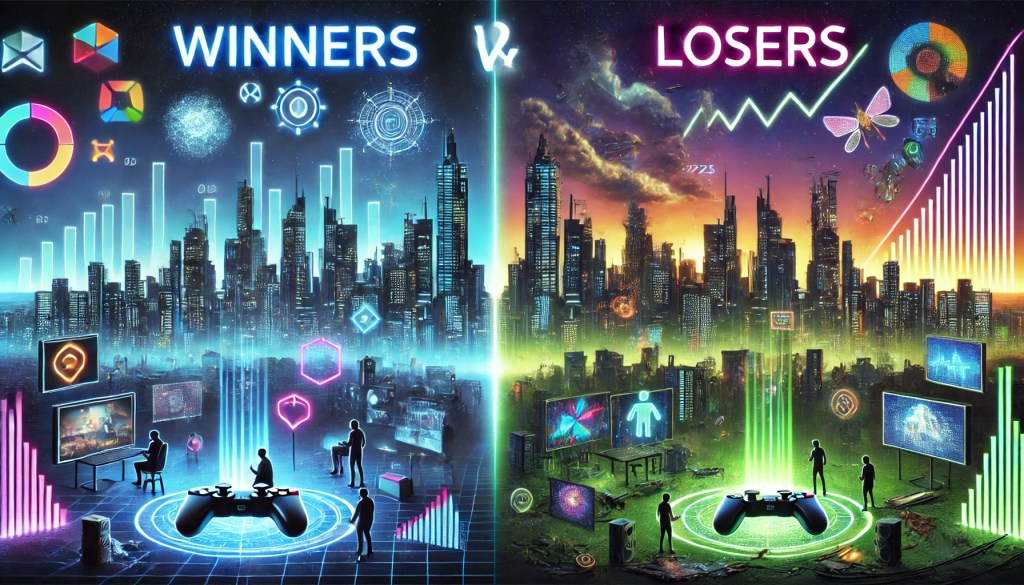
From PlayStation’s reign to Embracer’s downfall—Inside the gaming industry’s biggest successes and failures.
The Battle for Gaming Supremacy
The gaming industry in 2025 is a battlefield. Some companies are thriving, breaking revenue records and cementing their dominance. Others are collapsing under bad decisions, player backlash, and financial turmoil. It’s a defining moment—who will rise, and who will fall?
Sony, Microsoft, Nintendo, and Tencent have solidified their positions as industry leaders. Their strategies—whether through exclusive titles, cloud gaming, or mobile dominance—have reshaped the gaming landscape. With massive acquisitions, next-gen hardware, and record-breaking game sales, these giants have only gotten stronger.
But not everyone is winning.
Ubisoft, Electronic Arts (EA), Embracer Group, and Warner Bros. Games have struggled to keep up. Failed launches, mismanagement, and player frustration have led to layoffs, stock crashes, and dwindling brand trust. Some companies are trying to recover—others may not survive.
Why are some companies thriving while others are falling apart? This analysis will break down:
✔ Who’s winning and why—The companies leading the industry and their formula for success.
✔ Who’s losing and why—The companies facing backlash, layoffs, and declining revenues.
✔ What this means for the future of gaming—The trends that will shape the industry in the coming years.
Let’s start with the big winners of 2025.
Sony (PlayStation) – The Console King
📊 Revenue (2024): $31 billion
📈 Market Cap: $130 billion+
📉 Stock Performance: Up 18% YoY
If there’s one company truly dominating gaming in 2025, it’s Sony. With the PlayStation 5 still leading console sales, massive blockbuster exclusives, and a strategic expansion beyond traditional hardware, Sony remains the king of the gaming industry.
Why Sony is Winning in 2025
Sony’s success comes from three key strategies:
1️⃣ PlayStation’s Exclusive Games Continue to Dominate
While other companies are focusing on live-service titles and microtransactions, Sony doubled down on what works: single-player, story-driven exclusives.
Major Hits in 2024-2025:
- Spider-Man 2 – Sold 10+ million copies in under 6 months.
- God of War: Ragnarok (Director’s Cut) – Huge success with new story content.
- The Last of Us Multiplayer Experience – Finally launched, attracting millions of players worldwide.
Impact: These exclusives have ensured that PlayStation remains the preferred console for premium gaming experiences.
2️⃣ The PlayStation 5 Pro Gives Sony a Hardware Advantage
The release of the PS5 Pro in 2024 gave Sony an edge over Xbox.
📊 PS5 console sales have now surpassed 50 million units worldwide, with the Pro model accounting for 20% of total PlayStation sales within six months.
Why it matters:
✅ Higher performance → More gamers upgrading from PS5 to PS5 Pro.
✅ Future-proofing for next-gen games → Keeps PlayStation ahead of hardware competition.
3️⃣ Expanding Beyond Consoles – PC, Streaming & Subscriptions
Sony is no longer just a console company. It’s rapidly expanding into PC and cloud gaming to maximize revenue beyond PlayStation hardware.
💻 Major PC Launches in 2024-2025:
- The Last of Us Part II Remastered – 2 million+ sales on PC.
- Horizon Forbidden West – Massive success on Steam & Epic Games Store.
- More exclusives coming to PC within a year of their PlayStation launch.
Sony’s PlayStation Plus subscription model has also been upgraded, adding day-one releases for first-party games, making it a true competitor to Xbox Game Pass.
Sony’s Financial & Market Impact
- Total Revenue (2024-2025): $31 billion (gaming division).
- Stock Growth: Up 18% YoY, outperforming industry averages.
- PS5 Pro sales drive increased revenue, keeping PlayStation the most profitable console brand.
Gamer Sentiment
“PlayStation still has the best exclusives, but they better not ruin things with too many live-service games.”
Sony’s expansion into live-service gaming has some fans worried, but for now, its core strength in high-quality exclusives keeps it on top.
Microsoft (Xbox) – Game Pass is Their Golden Ticket
📊 Revenue (2024): $21.5 billion
📈 Market Cap: $2.8 trillion (Microsoft as a whole)
📉 Stock Performance: Up 12% YoY
If Sony is dominating through exclusive single-player experiences, Microsoft is playing an entirely different game—and winning in its own way. Instead of focusing purely on hardware sales, Microsoft has bet everything on Game Pass, cloud gaming, and major acquisitions.
It’s a strategy that’s taken years to pay off, but in 2025, Xbox is stronger than ever.
Why Microsoft is Winning in 2025
Microsoft’s success is built on three key pillars:
1️⃣ Xbox Game Pass is Still the Best Deal in Gaming
In 2025, Game Pass remains the industry’s most powerful subscription model. With 38 million active subscribers, it has become a core part of how gamers access new titles.
Why Game Pass is Working:
- Day-one releases for Xbox exclusives (no need to pay $70 per game).
- Hundreds of games on-demand (across console, PC, and cloud).
- More revenue stability (steady income vs. risky one-time game sales).
Financial Impact:
- Game Pass generates over $4 billion annually.
- 60% of Game Pass subscribers play across PC, Xbox, and cloud gaming.
- Microsoft has locked players into its ecosystem, keeping engagement and spending high.
Gamer Sentiment:
“Game Pass is the best deal in gaming… but where are the must-play Xbox exclusives?”
2️⃣ Activision Blizzard & Bethesda Acquisitions Are Paying Off
Microsoft spent nearly $80 billion acquiring Activision Blizzard and Bethesda, and in 2025, the investment is finally delivering results.
Biggest Wins from Acquisitions:
- Call of Duty: Black Ops 6 launched day one on Game Pass, hitting 25 million downloads in its first week.
- Starfield struggled initially but saw a massive resurgence with new expansions.
- Diablo IV’s live service model brought in over $800 million in microtransactions in 2024 alone.
What This Means for Microsoft:
- Microsoft now owns some of the most powerful franchises in gaming.
- Call of Duty on Game Pass gives Xbox a massive advantage in the FPS market.
- Bethesda and Blizzard’s franchises keep players locked into Microsoft’s ecosystem.
3️⃣ Cloud Gaming Expansion Brings Xbox to More Players
While PlayStation still dominates hardware, Microsoft is thinking bigger—making Xbox available on any device through cloud gaming.
Cloud gaming impact in 2025:
- Xbox Game Pass Ultimate now includes full cloud support, allowing high-end games to run on phones, tablets, and smart TVs.
- Emerging markets (like India, Brazil, and Africa) are growing fast, as gamers can access Xbox without buying expensive consoles.
- Microsoft’s Azure servers give it a cloud infrastructure advantage over Sony and Nintendo.
Why This Matters:
Microsoft is future-proofing its platform, ensuring that even if console sales slow down, Xbox will still be accessible worldwide.
Microsoft’s Financial & Market Impact
- Total Revenue (2024-2025): $21.5 billion from gaming.
- Stock Growth: Up 12% YoY, driven by Game Pass expansion and Call of Duty’s performance.
- Cloud gaming investments are expected to bring another 20 million new players into the Xbox ecosystem by 2027.
Gamer Sentiment
“Game Pass is amazing, but Microsoft still doesn’t have the same killer exclusives as PlayStation.”
While Game Pass is universally praised, Microsoft still struggles to deliver truly groundbreaking exclusives outside of its acquired studios. Players want to see new IPs that define Xbox, not just multiplatform hits.
Tencent – The Quiet Giant of Gaming
- Revenue (2024): $86 billion
- Market Cap: $380 billion
- Stock Performance: Stable, but Western regulatory concerns limit growth
While Sony and Microsoft dominate the console market, Tencent quietly remains the world’s largest gaming company. Unlike its Western counterparts, Tencent thrives in mobile gaming, live-service monetization, and strategic investments in top studios worldwide.
Despite increasing regulations from the Chinese government, Tencent continues to expand its global influence, acquire stakes in major gaming companies, and generate billions through mobile microtransactions.
Why Tencent is Winning in 2025
Tencent’s success comes from three major factors:
1️⃣ Mobile Gaming Domination – Billions in Revenue
While many gaming companies focus on consoles and PC, Tencent is the undisputed king of mobile gaming.
Tencent’s Biggest Mobile Hits in 2025:
- Honor of Kings – Still the #1 highest-grossing mobile game worldwide.
- PUBG Mobile – Generates billions in microtransactions every year.
- League of Legends: Wild Rift – Keeps Tencent’s grip on the MOBA market.
Why Mobile Gaming Makes Tencent So Powerful:
- Low development costs compared to AAA console games.
- Faster return on investment (players spend daily on microtransactions).
- Billions of potential players (mobile gaming is the largest segment of the industry).
Financial Impact:
- Mobile games account for over 60% of Tencent’s gaming revenue.
- Honor of Kings alone generated $3 billion in 2024 through in-game purchases.
2️⃣ Strategic Investments in Global Gaming Companies
Tencent owns, invests in, or controls some of the biggest studios in the world.
Tencent’s Key Investments in 2025:
- Riot Games (100% ownership) → League of Legends, Valorant.
- Epic Games (40% ownership) → Fortnite, Unreal Engine.
- Ubisoft (49% stake) → Assassin’s Creed, Far Cry.
- Activision Blizzard (5% stake) → Call of Duty, World of Warcraft.
Why this strategy works:
✅ Tencent doesn’t need to develop new franchises—it profits from others.
✅ It can influence global gaming while staying behind the scenes.
✅ The company’s reach extends beyond China—it’s deeply embedded in Western gaming.
3️⃣ AI-Driven Engagement & Monetization
Tencent is leading the AI revolution in gaming, using machine learning to drive engagement and player spending.
How Tencent Uses AI in Gaming:
- Personalized in-game purchases (AI suggests skins & items based on play style).
- Retention algorithms (Keeps players engaged longer = more revenue).
- AI-generated game updates (Analyzing player behavior to adjust difficulty & rewards).
Stock Performance: Tencent remains China’s gaming powerhouse, but regulatory concerns continue to limit stock growth in Western markets.
Gamer Sentiment
“Tencent has money, but all their games feel like cash grabs.”
Western gamers generally dislike Tencent’s monetization-heavy approach, but Tencent doesn’t need their approval—billions of mobile players in Asia drive its success.
Nintendo – Nostalgia Meets Innovation
- Revenue (2024): $14.8 billion
- Market Cap: $75 billion
- Stock Performance: Stable, with a potential surge expected from the Switch 2 launch
While Sony and Microsoft fight for high-end gaming dominance, Nintendo continues to succeed on its own terms. With its legendary franchises, family-friendly approach, and a strong hardware-software synergy, Nintendo remains one of the most beloved gaming companies in the world.
In 2025, Nintendo is in a transition year, preparing for the launch of its next-generation console while capitalizing on its iconic IPs.
Why Nintendo is Winning in 2025
Nintendo’s success is built on three key strategies:
1️⃣ Timeless Franchises That Sell for Decades
Nintendo has what no other gaming company has—a collection of universally loved franchises that generate billions without needing heavy monetization or microtransactions.
Best-Selling Nintendo Games in 2024-2025:
- Zelda: Tears of the Kingdom (DLC expansion release) → Keeps Zelda at the top of the charts.
- Super Mario Bros. Wonder → Continues to sell millions of copies worldwide.
- Metroid Prime 4 → Long-awaited release excites hardcore fans.
- Pokémon Legends: Z-A (Announced for Switch 2) → Expected to be another massive success.
Why This Strategy Works:
- Nintendo doesn’t need live-service games or microtransactions—players happily pay $60-$70 upfront for its premium games.
- These franchises are evergreen—a new Mario or Zelda game will always be a hit.
- Nintendo dominates family-friendly gaming, capturing a different audience than Sony/Microsoft.
Financial Impact:
- Nintendo’s software sales continue to generate steady revenue, with Zelda, Mario, and Pokémon accounting for over 70% of its top-performing titles.
2️⃣ The Nintendo Switch 2 is Coming – A Big Leap Forward
The biggest shift for Nintendo in 2025 is the anticipated release of its next-generation console, the Switch 2.
What We Know About the Switch 2:
- Expected to launch late 2025 or early 2026.
- Will likely continue the hybrid design (portable + docked play).
- More powerful hardware to compete with modern game engines.
Why this matters:
✅ The Switch is now aging—a new console is needed to keep Nintendo competitive.
✅ A major launch will boost software and hardware sales, leading to a stock surge.
Stock Impact:
- Investors are closely watching the Switch 2 launch, expecting a major revenue spike.
- If the launch succeeds, Nintendo’s stock could see a significant jump.
3️⃣ Global Appeal & Unique Market Positioning
Unlike PlayStation and Xbox, Nintendo isn’t competing for the same audience.
Who Buys Nintendo Games?
- Families & younger players (safe, easy-to-play games).
- Longtime fans & collectors (nostalgic appeal).
- Casual gamers (who may not own a PlayStation/Xbox).
This means Nintendo doesn’t need to fight Microsoft or Sony directly—it wins by playing its own game.
Nintendo’s Financial & Market Impact
- Total Revenue (2024-2025): $14.8 billion
- Stock Growth: Stable, with a potential major boost from Switch 2.
- Future Growth Outlook: Highly dependent on the success of its new console.
Gamer Sentiment
“Nintendo makes masterpieces, but why do they act like it’s still 2005?”
Nintendo’s games are still beloved, but fans are frustrated with its outdated online services, hardware limitations, and slow adaptation to modern trends. The Switch 2 launch will be a critical test for Nintendo’s future.
Let’s now move on to the big losers of 2025.
Ubisoft – The King of Cancellations & Disappointment
- Revenue (2024): $2.2 billion (down 14% YoY)
- Market Cap: $4.5 billion (down from $6.7 billion in 2023)
- Stock Performance: Dropped 28% YoY after a series of failed releases and cancellations
Ubisoft was once a pillar of the gaming industry, known for blockbuster franchises like Assassin’s Creed, Far Cry, and Rainbow Six. However, in 2025, Ubisoft is struggling to stay relevant as players grow tired of its repetitive formula, delays, and corporate mismanagement.
The company bet big on live-service gaming, but its strategy has backfired badly.
Why Ubisoft is Failing in 2025
Ubisoft’s downfall comes from three major failures:
1️⃣ A Cycle of Game Delays, Cancellations & Underwhelming Releases
Ubisoft has gained a reputation for promising games that never seem to launch.
Games That Were Delayed or Canceled in 2024-2025:
- ❌ Skull & Bones – Delayed seven times over six years, finally launched to mediocre reviews.
- ❌ Beyond Good & Evil 2 – Still nowhere to be seen, making it one of the most delayed games in history.
- ❌ Splinter Cell Remake – Development stalled, leading to speculation about a possible cancellation.
Financial Impact:
- The constant delays have cost Ubisoft millions in development costs.
- Investors lost confidence, causing stock to drop nearly 30% in 2024 alone.
Gamer Sentiment:
“Ubisoft announces games, then disappears for five years. By the time they release, no one cares anymore.”
2️⃣ The Ubisoft Open-World Formula Feels Stale
For years, Ubisoft relied on the same open-world game design—a huge map filled with repetitive side quests, towers to climb, and grind-heavy mechanics.
Why Players Are Losing Interest:
- Far Cry, Assassin’s Creed, and Watch Dogs all feel the same.
- The “Ubisoft formula” is outdated, with too many checklists and busywork mechanics.
- Even Assassin’s Creed Mirage—designed as a “return to the franchise’s roots”—failed to excite many longtime fans.
Industry Trend:
- Players are gravitating toward more handcrafted, story-driven games (Elden Ring, Baldur’s Gate 3), leaving Ubisoft struggling to stay relevant.
Gamer Sentiment:
“Every Ubisoft game feels like a copy-paste version of the last one.”
3️⃣ Live-Service Gaming Strategy Backfired
Ubisoft shifted its focus to live-service games, but the results have been disastrous.
Live-Service Projects That Failed:
- XDefiant – Ubisoft’s answer to Call of Duty failed to gain traction due to poor balancing and lack of content.
- The Division: Heartland – Delayed multiple times and eventually shelved indefinitely.
- Ghost Recon Frontline – Announced in 2021, canceled before launch.
Why This Strategy Failed:
- Ubisoft doesn’t have a strong multiplayer identity—unlike Activision (Call of Duty) or Riot Games (League of Legends).
- The market is already oversaturated with live-service shooters.
- Players aren’t interested in Ubisoft’s attempts at creating “forever” games.
Financial Impact:
- Ubisoft wasted millions in development costs on games that never launched or flopped quickly.
- Investors lost confidence in Ubisoft’s leadership, questioning whether the company has a clear direction.
Gamer Sentiment:
“Ubisoft keeps trying to make live-service games, but nobody is asking for them.”
Ubisoft’s Financial & Market Impact
- Total Revenue (2024-2025): $2.2 billion (down 14% YoY).
- Stock Drop: -28% YoY, one of the worst in the industry.
- Future Outlook: Unless Ubisoft reinvents itself, it risks becoming irrelevant.
Gamer Sentiment
“Ubisoft just makes the same game over and over. And when they try something new, it sucks.”
Ubisoft desperately needs fresh ideas, but instead, it’s stuck in a cycle of delays, cancellations, and outdated game design. If the company doesn’t course-correct soon, it may not survive the next console generation.
Electronic Arts (EA) – The Microtransaction Monster
- Revenue (2024): $7.2 billion (down 9% YoY)
- Market Cap: $27 billion (down from $32 billion in 2023)
- Stock Performance: Dropped 22% YoY after microtransaction backlash and franchise fatigue
Electronic Arts (EA) has always been a controversial force in gaming, balancing financial success with gamer frustration over aggressive monetization. In 2025, that tension has reached a breaking point—players are fed up, key franchises are declining, and investors are losing faith.
Despite maintaining some top-selling franchises, EA is now struggling under the weight of its own greed-driven strategies.
Why EA is Failing in 2025
EA’s struggles come down to three major issues:
1️⃣ Ultimate Team & Microtransaction Greed Backlash
EA’s biggest money-maker has always been Ultimate Team (formerly in FIFA, now in EA Sports FC), where players buy digital card packs to build their dream teams.
But in 2025, the backlash against EA’s pay-to-win model has finally boiled over.
What Happened?
- European regulators cracked down on Ultimate Team, labeling it gambling for minors.
- New laws forced EA to disclose loot box odds more transparently.
- Player spending dropped significantly as users boycotted the exploitative system.
Financial Impact:
- EA’s Ultimate Team revenue dropped 14% YoY, leading to a stock decline of 22%.
- Investors are worried about future regulatory action, which could further restrict EA’s biggest cash cow.
Gamer Sentiment:
“EA Sports FC is just FIFA with a new name—and they still want me to spend thousands to get good players.”
2️⃣ EA is Bleeding Its Core Franchises Dry
For years, EA has relied on yearly sequels in franchises like:
- EA Sports FC (formerly FIFA) – Sales dropped by 12%, partly due to negative player sentiment.
- Battlefield – After the Battlefield 2042 disaster, the series is still struggling to recover.
- The Sims – The Sims 5 was announced, but fans are already worried about microtransactions.
Why This Strategy is Failing:
- Players are losing trust in EA’s ability to deliver fresh, innovative experiences.
- Instead of improving gameplay, EA focuses on monetization.
- Competitors like 2K Sports and Konami’s eFootball are taking market share in sports gaming.
Financial Impact:
- Battlefield’s player base dropped 60% compared to past entries.
- EA Sports FC underperformed expectations, raising concerns about long-term franchise fatigue.
Gamer Sentiment:
“Every EA game feels like a lazy cash grab. They don’t care about fun, just profit.”
3️⃣ Studio Mismanagement & Failed AAA Launches
EA owns some of the best studios in the industry, but poor management has hurt its biggest franchises.
Key EA Failures in 2024-2025:
- ❌ Dragon Age: The Veilguard – Overhyped but delayed multiple times, leading to player frustration.
- ❌ Skate 4 – Initially a free-to-play model, but fan backlash forced EA to rethink its strategy.
- ❌ Need for Speed – The series lost relevance, with the 2024 installment failing to gain traction.
Why This Strategy is Failing:
- EA focuses on monetization first, gameplay second.
- The constant delays and development issues make EA look disorganized and profit-driven.
Stock Performance: EA’s stock dropped 22% as investors lost confidence in its ability to produce hit games.
Gamer Sentiment:
“EA buys great studios and then ruins them. They never learn.”
EA’s Financial & Market Impact
- Total Revenue (2024-2025): $7.2 billion (down 9% YoY).
- Stock Drop: -22% YoY, mostly due to microtransaction backlash.
- Future Outlook: If EA doesn’t reinvent its approach, it risks falling further behind competitors.
Gamer Sentiment
“EA only cares about money, not gamers.”
EA’s relentless focus on live-service models and monetization is alienating its player base. If the company doesn’t address fan concerns and start delivering great games, it risks a long-term decline.
Embracer Group – From Expansion to Collapse
- Revenue (2024): $3.1 billion (down 18% YoY)
- Market Cap: $2.7 billion (down from $9 billion in 2022, a staggering decline)
- Stock Performance: Collapsed 65% YoY due to failed acquisitions, studio closures, and financial struggles
Embracer Group was once the fastest-growing gaming company in the world. Through an aggressive acquisition spree, the company bought over 100 studios, acquiring major IPs like Tomb Raider, Deus Ex, The Lord of the Rings, and Borderlands.
But by 2025, the dream has turned into a nightmare. Instead of becoming the next gaming giant, Embracer is now fighting for survival.
What went wrong? A combination of overexpansion, poor financial planning, and a failed $2 billion deal that sent the company into chaos.
Why Embracer is Failing in 2025
Embracer’s downfall is driven by three critical mistakes:
1️⃣ Overexpansion Without a Sustainable Business Model
Between 2020 and 2023, Embracer went on an unprecedented shopping spree, acquiring:
- Gearbox Software (Borderlands)
- Crystal Dynamics & Eidos Montréal (Tomb Raider, Deus Ex)
- Saber Interactive (World War Z, Evil Dead)
- The Lord of the Rings IP rights
The Problem?
Embracer had no clear plan on how to monetize all these assets. Instead of focusing on fewer, high-quality games, it spread itself too thin across too many projects.
Financial Impact:
- Operating costs ballooned, making profitability nearly impossible.
- Investors became skeptical, leading to a massive stock sell-off.
Gamer Sentiment:
“Embracer bought everything… and ruined it all.”
2️⃣ The Failed $2 Billion Saudi Investment That Destroyed Everything
In 2023, Embracer was expecting a $2 billion investment from Saudi Arabia, which was meant to fund its aggressive growth strategy.
What Happened?
- The deal fell through at the last minute, leaving Embracer with massive debts and no financial backup plan.
- The company was forced into emergency cost-cutting, leading to widespread layoffs and studio closures.
Stock Performance:
- After the failed deal, Embracer’s stock plummeted by 65%.
- Investors lost all confidence, fearing financial collapse.
Gamer Sentiment:
“They bet everything on one deal. When it failed, they had no backup plan.”
3️⃣ Studio Closures & Project Cancellations
To stay afloat, Embracer shut down or sold off multiple studios, leading to thousands of layoffs.
Studios That Were Closed or Sold Off in 2024-2025:
- ❌ Volition (Saints Row) – Shut down after the Saints Row reboot flopped.
- ❌ Free Radical (TimeSplitters) – Canceled before it even got started.
- ❌ Saber Interactive – Sold off to private investors after Embracer couldn’t afford to keep it.
- ❌ Crystal Dynamics & Eidos Montréal – Sold Tomb Raider and Deus Ex back to a bigger publisher.
Why This Strategy is Failing:
- Developers lost trust in Embracer, with many key talent members leaving.
- The company is now worth a fraction of its former valuation.
- Gamers no longer believe Embracer can deliver on its promises.
Financial Impact:
- Embracer lost billions in value by buying studios it couldn’t afford.
- The company is now desperately trying to sell off more assets to avoid bankruptcy.
Gamer Sentiment:
“They bought my favorite studios and then killed them off. Absolute disaster.”
Embracer’s Financial & Market Impact
- Total Revenue (2024-2025): $3.1 billion (down 18% YoY).
- Stock Drop: -65% YoY, the worst in the gaming industry.
- Future Outlook: Embracer is now in survival mode—it must sell assets or face collapse.
Gamer Sentiment
“Embracer tried to be the Disney of gaming, but instead, they destroyed everything they touched.”
Embracer grew too fast and collapsed under its own weight. Now, it’s a shadow of its former self, desperately trying to sell off studios and IPs just to stay afloat.
If the company doesn’t find a way to stabilize, it may not survive past 2026.
Warner Bros. Games – The Live-Service Disaster
📊 Revenue (2024): $2.8 billion (down 12% YoY)
📉 Market Cap: $5.4 billion (down from $7.1 billion in 2023)
📉 Stock Performance: Dropped 18% YoY after major live-service failures
Warner Bros. Games was once seen as one of the strongest publishers in gaming, with massive franchises like Batman, Harry Potter, and Mortal Kombat. However, 2025 has been a disaster as WB Games pivoted too aggressively toward live-service gaming—only to see those projects crash and burn.
Instead of capitalizing on strong single-player titles, Warner Bros. bet on monetized, always-online experiences—and players rejected them.
Why Warner Bros. Games is Failing in 2025
The downfall of WB Games is driven by three key mistakes:
1️⃣ The Multiversus Fiasco – From Hype to Failure
WB’s biggest live-service bet was Multiversus, a Smash Bros.-style fighting game featuring characters from DC, Looney Tunes, Game of Thrones, and more.
What Went Wrong?
- The game launched in 2022 in beta, built hype, then completely disappeared for over a year.
- When it re-released in 2024, players were frustrated by:
- Aggressive monetization (locking characters behind paywalls).
- Terrible matchmaking and lag issues.
- Lack of meaningful content updates.
- By early 2025, Multiversus had lost over 90% of its player base.
Financial Impact:
- Warner Bros. invested millions into Multiversus, expecting it to be a long-term live-service hit.
- Instead, it flopped hard, damaging the company’s reputation.
Gamer Sentiment:
“They had the perfect crossover fighting game… and they ruined it with greed.”
2️⃣ The Live-Service Obsession Backfires
WB Games decided to move away from traditional single-player games and focus on live-service titles.
Failed Live-Service Experiments in 2024-2025:
- Suicide Squad: Kill the Justice League – Launched as a live-service shooter… and flopped immediately.
- Harry Potter: Quidditch Champions – A standalone Quidditch game that failed to excite players.
- Gotham Knights (2023) – Failed to gain long-term engagement due to bad combat and repetitive missions.
Why This Strategy Failed:
- WB Games ignored what players actually wanted—single-player experiences like Batman: Arkham or Hogwarts Legacy.
- The market is already oversaturated with live-service games, making it difficult to compete.
Financial Impact:
- Suicide Squad was one of the biggest commercial disappointments of the year, leading to massive layoffs at WB Montreal.
- WB Games had to scrap several upcoming live-service projects due to lack of interest.
Gamer Sentiment:
“We just wanted more great single-player DC and Harry Potter games. Why did WB try to make everything online and monetized?”
3️⃣ The One Bright Spot: Mortal Kombat Remains Strong
The only thing keeping WB Games alive in 2025 is the continued success of Mortal Kombat 1.
Why Mortal Kombat Works:
- Strong offline and online play keeps players engaged.
- Regular character DLC keeps the game fresh.
- Fighting games are naturally competitive, so monetization doesn’t feel forced.
Revenue Impact:
- Mortal Kombat 1 was WB’s only major gaming success in 2024-2025.
- Without it, WB Games’ losses would be even worse.
Gamer Sentiment:
“Mortal Kombat is still great, but the rest of WB’s gaming division is a mess.”
Warner Bros. Games’ Financial & Market Impact
- Total Revenue (2024-2025): $2.8 billion (down 12% YoY).
- Stock Drop: -18% YoY, as investors lost confidence in WB’s live-service push.
- Future Outlook: WB must return to strong single-player franchises or risk further decline.
Gamer Sentiment
“WB had amazing franchises and still managed to screw them up. Just make good games and stop forcing live-service garbage.”
Warner Bros. Games bet everything on live-service, and it failed spectacularly. If they don’t pivot back to high-quality single-player games, they risk falling behind forever.
What This Means for the Future of Gaming
The gaming industry in 2025 is at a major turning point. The biggest winners—Sony, Microsoft, Tencent, and Nintendo—have secured their dominance through a mix of exclusive games, subscriptions, mobile dominance, and hardware innovation.
Meanwhile, the biggest losers—Ubisoft, EA, Embracer, and Warner Bros. Games—are struggling due to bad management, failed live-service experiments, and financial missteps.
So, what does this mean for the future of gaming?
1️⃣ The End of the Live-Service Gold Rush?
For years, publishers chased the dream of live-service gaming, hoping to create the next Fortnite or Call of Duty: Warzone.
But in 2025, we’re seeing the limits of this model.
The Reality:
- Players are burnt out on constant monetization and battle passes.
- Too many live-service games = not enough players to sustain them all.
- Single-player, premium experiences are making a comeback.
Prediction: Publishers will shift back toward strong single-player games as live-service fatigue sets in.
What to Watch: Will WB Games and Ubisoft learn from their mistakes and start focusing on high-quality single-player titles again?
2️⃣ Subscription Services Are Reshaping the Industry
Sony’s PlayStation Plus and Microsoft’s Game Pass have proven that subscription-based gaming is here to stay.
The Numbers Don’t Lie:
- Game Pass (38M subscribers) and PS Plus (50M subscribers) are now major revenue drivers.
- More players are choosing subscriptions over paying $70 per game.
- Day-one releases on subscription services are reshaping how games are launched.
Prediction: More publishers will sign deals with Game Pass & PlayStation Plus, ensuring bigger, day-one launches on these platforms.
What to Watch: Will Nintendo finally launch a serious Game Pass competitor for the Switch 2?
3️⃣ Cloud Gaming & AI Personalization Are Expanding
Gaming is no longer limited to consoles and PCs—Microsoft and Tencent are leading the way in cloud gaming and AI-driven personalization.
Key Trends:
- Cloud gaming is growing fast in emerging markets (India, Brazil, Africa).
- AI-driven game recommendations are keeping players engaged longer.
- More mobile players are entering the gaming ecosystem than ever before.
Prediction: Cloud gaming won’t replace traditional consoles yet, but it will continue growing, especially in markets where hardware is expensive.
What to Watch: Will Microsoft’s cloud-first strategy give it an edge over PlayStation in the long run?
4️⃣ Game Publishers Must Listen to Players—Or Risk Collapse
Embracer’s downfall and EA’s microtransaction backlash have shown that players will no longer tolerate anti-consumer practices.
Lessons Learned in 2025:
- If you buy too many studios (Embracer), you will crash.
- If you over-monetize (EA, Ubisoft), players will leave.
- If you focus on live-service and ignore single-player (WB Games), you will fail.
Prediction: The next wave of gaming will be defined by studios that actually respect player feedback.
💡 What to Watch: Will Ubisoft reinvent its open-world formula to keep players engaged?
My Personal Thoughts
The gaming industry in 2025 is at a crossroads. The companies that have succeeded—Sony, Microsoft, Tencent, and Nintendo—did so by understanding their audience, adapting to market shifts, and focusing on strong content.
Meanwhile, Ubisoft, EA, Embracer, and Warner Bros. Games are facing serious consequences for failing to listen to players and mismanaging their strategies.
The Key Takeaways from 2025:
✔ Single-player games are making a comeback as players push back against aggressive live-service monetization.
✔ Subscription services like Game Pass and PlayStation Plus are reshaping game launches and distribution.
✔ Cloud gaming and AI-driven engagement are growing, especially in emerging markets.
✔ Companies that chase short-term profit over player experience are seeing major financial losses.
The industry is shifting—and companies that don’t adapt will be left behind.
What’s Next?
The next few years will determine which companies will continue to thrive and which will fade into irrelevance. The biggest questions going forward:
- Will Ubisoft reinvent itself, or will it continue to struggle with repetitive open-world design?
- Can EA survive if governments continue cracking down on Ultimate Team loot boxes?
- Will Embracer recover, or will it collapse entirely?
- Can WB Games stop forcing live-service into its franchises and return to quality single-player games?
The answers to these questions will shape the future of gaming.
What Do You Think?
- Which gaming companies do you think will rise or fall next?
- Do you believe live-service gaming is dying, or will it make a comeback?
- Will Nintendo’s Switch 2 be a game-changer, or is it too late?
Drop your thoughts in the comments and join the discussion!
Stay ahead of gaming trends—subscribe to our newsletter for the latest insights!
External Sources Used
For transparency and further reading, here are some of the key sources that shaped this analysis:
Financial Reports & Market Data:
- Sony’s Q2 FY2024 Consolidated Financial Results:
This report provides detailed insights into Sony’s financial performance for the quarter ending September 30, 2024, highlighting a 3% year-on-year increase in consolidated sales, reaching ¥2.9056 trillion. - Microsoft’s FY2024 Q4 More Personal Computing Performance:
This document details Microsoft’s gaming revenue surge, with a 39% increase driven by growth in Xbox content and services. - Microsoft’s Quarterly Gaming Revenue Analysis:
Statista’s report indicates that in the fiscal quarter ending December 2024, Microsoft generated approximately $6.58 billion through its gaming segment.
Industry Trends & Market Analysis:
- PlayStation’s Record-Breaking Quarter:
MIDiA Research discusses how PlayStation achieved record hardware and active user numbers in Q4 2024, with G&NS revenues reaching $10.6 billion, up 16% year-on-year. - Microsoft’s Gaming Revenue Surge Post-Activision Acquisition:
An analysis by GamesIndustry.biz reveals that Microsoft’s gaming revenue increased by 43% year-on-year, significantly boosted by the Activision Blizzard acquisition.
Gaming Reviews & Player Sentiment:
- Microsoft’s Gaming Revenue Growth Amidst Hardware Sales Decline:
The Verge reports on Microsoft‘s continued gaming revenue growth, noting a 61% increase in Xbox software revenues, despite a decline in hardware sales. - Xbox Revenue and Hardware Performance:
VGChartz highlights that for the entire 2024 fiscal year, Xbox gaming generated $21.50 billion, up from $15.47 billion in 2023, while also noting a decline in hardware revenue.
These sources offer in-depth data, industry analyses, and expert opinions, ensuring that the information presented in this article is accurate, relevant, and backed by real-world insights.