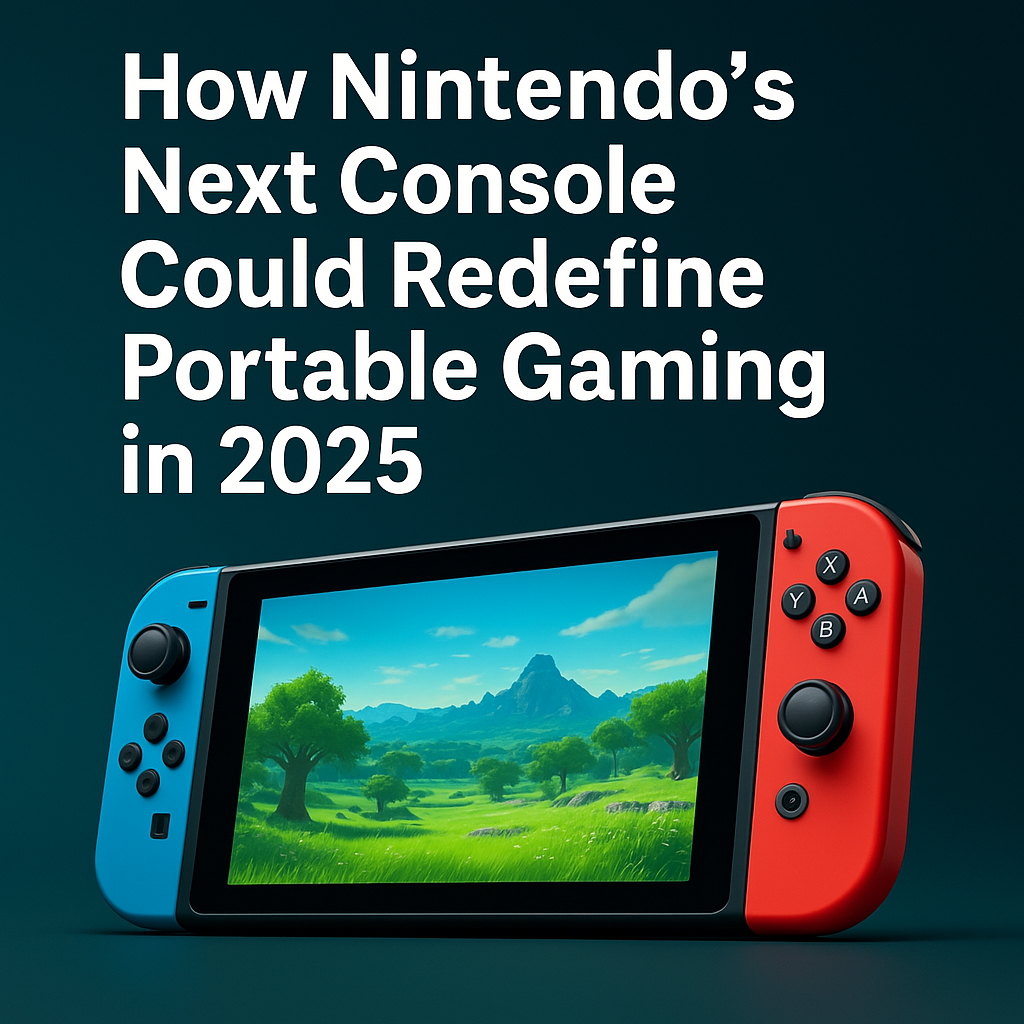
Can Nintendo Capture Lightning in a Bottle—Again?
Update. April 2nd 2025: Nintendo just dropped the Switch 2. Not a refresh: a reinvention. 4K. 120FPS. Voice chat. Camera. Mouse-control Joy-Cons.
Eight years after the first Switch, they’re not iterating. They’re restarting.
Nearly eight years after the original Nintendo Switch revolutionized hybrid gaming, anticipation around its successor has reached a fever pitch. As the world tunes into today’s long-awaited Nintendo Direct, the company stands at a familiar crossroads—betting big on innovation while carefully preserving its vast ecosystem of players, developers, and beloved IP.
Our hypothesis? Nintendo will unveil more than just upgraded hardware. If the signs are accurate, the Switch 2 represents a calculated pivot: a move toward second-screen experimentation, performance parity with newer consoles, and deeper cross-generational continuity. The inclusion of backwards compatibility, upgraded Joy-Con designs, and enhanced legacy ports hints at a broader strategy—bridging past success with future potential.
With major titles like Metroid Prime 4: Beyond, Mario Kart 9, and a rumored new 3D Mario adventure poised to define the console’s launch year, this Direct could mark the start of one of the most significant transitions in modern gaming.
But the question remains: can Nintendo pull off another generational leap—this time, in a world dominated by PS5s, Xbox Game Pass, and handheld PC rigs? What we learn today could define the next decade of gaming.
Release Date & Strategic Timing
Nintendo Bets on a Mid-Year Launch to Maximize Breathing Room and Buzz
Unlike the original Switch, which launched in early March 2017 alongside Breath of the Wild, the Nintendo Switch 2 appears to be headed for a mid-2025 release, with analysts and insiders pointing to a June window. While Nintendo has yet to confirm the exact date, this shift in timing is far from arbitrary.
Industry observers suggest the company is strategically avoiding Q1 noise from financial earnings cycles and competing releases, instead carving out a quiet, spacious mid-year window that gives it room to dominate headlines and stabilize global supply chains. A summer launch also builds momentum ahead of the high-stakes Q4 holiday period, when a second wave of exclusive titles is rumored to arrive.
This two-wave approach mirrors Nintendo’s “slow-burn strategy” from 2017: after a bold launch, the company spaced out marquee titles like Mario Kart 8 Deluxe, Arms, and Super Mario Odyssey to maintain media traction and sales momentum across quarters.
From a business perspective, the mid-year release accomplishes three things:
- Spreads production stress over a longer ramp-up period, mitigating chip shortage risks.
- Maximizes software attach rates, as players gradually build their libraries in time for holiday bundles.
- Offsets direct competition with Grand Theft Auto VI and next-gen PC handhelds expected to dominate late 2025 headlines.
Nintendo’s decision here also reflects a shift in consumer behavior. As digital marketplaces grow and retail seasonality weakens, companies are increasingly launching hardware on their own terms—a strategy that worked well for Sony’s PS5 Slim refresh in mid-2023.
Still, timing is only one piece of the puzzle. With an audience primed for more than a performance bump, Nintendo must pair this launch window with bold creative choices and flawless execution. And that brings us to the next pressure point: price.
Price Point & Market Positioning
Balancing Familiarity and Future-Proofing: Can Nintendo Justify a $399 Price Tag?
With the original Switch launching at a consumer-friendly $299 in 2017, speculation surrounding the Switch 2’s price has become one of the most discussed aspects of its reveal. Early analyst predictions and insider reports suggest a retail price range between $399 and $499, depending on the edition and bundled features.
This positions the Switch 2 at a premium tier, potentially matching the base model PlayStation 5 or Xbox Series X—two powerhouses already entrenched in the living room. But Nintendo isn’t trying to compete on raw horsepower alone. Instead, it’s leveraging its unique hybrid identity, first-party titles, and ecosystem continuity to justify the price.
Here’s how Nintendo may be thinking:
Strategic Pricing Considerations:
- Backward compatibility with Switch 1 titles reduces switching friction and adds perceived value.
- The rumored inclusion of a larger 8-inch screen and improved Joy-Con tech (with magnetic snap-on and the mysterious new “C” button) suggests a more premium build.
- Bundled launch titles or subscription perks could soften the sticker shock.
Crucially, the pricing sweet spot may fall at $399/£349, allowing Nintendo to maintain margins without straying too far from its “family-friendly, accessible” ethos. Anything higher could risk alienating the broader audience that helped the original Switch top 139 million units in lifetime sales—surpassing even the Wii.
Competitive Positioning:
Compared to handheld PCs like the Steam Deck or ROG Ally, the Switch 2 won’t win a tech specs war—but it doesn’t need to. Nintendo’s strength lies in first-party software, nostalgia, and seamless hardware-software integration. In this sense, the higher price isn’t just about specs—it’s a ticket to Nintendo’s curated gaming universe.
In short: if Nintendo can pair this higher price with an irresistible software lineup and robust feature set, the Switch 2 could pull off what few hardware makers dare—charging more without losing their mainstream base.
Next up: what exactly will players be paying to play? Let’s look at the confirmed and expected launch games.
Confirmed & Expected Launch Titles
Nintendo’s Launch Arsenal: Familiar Franchises, Big Bets, and Strategic Sequels
A console lives or dies by its games—and Nintendo knows this better than anyone. If the original Switch taught us anything, it’s that a powerful first-party lineup can drive hardware adoption, define brand identity, and create cultural moments. The Nintendo Switch 2 appears set to follow that same formula, if not surpass it.
While full confirmation awaits today’s Direct, early signals and industry leaks suggest a launch year anchored by three cornerstone titles:
Mario Kart 9 (Unofficial title)
Expected to be the flagship multiplayer experience for the Switch 2, this next installment may showcase online innovations, tighter Joy-Con integration, and new course mechanics. With Mario Kart 8 Deluxe still topping sales charts years after launch, Nintendo faces the rare challenge of replacing a bestseller with something even bigger.
Metroid Prime 4: Beyond
After years of development and anticipation, Metroid Prime 4 was re-revealed last week with three minutes of gameplay footage. Sources suggest today’s Direct will confirm its role as a graphical showcase for the new hardware, pushing visual fidelity beyond anything seen on the original Switch. The title may also explore dual-screen features teased by patents filed earlier this year.
New 3D Super Mario Adventure
While still under wraps, insiders point to a new mainline Mario game—possibly a sequel to Super Mario Odyssey—as a near-lock. Mario has launched every Nintendo console since the N64 era, and a fresh 3D entry would cement the Switch 2’s identity from day one.
Other Likely Titles and Enhancements
- Pokémon Legends: Z-A – Positioned for early 2026, but possibly teased today.
- Enhanced ports of Tears of the Kingdom, Super Smash Bros. Ultimate, and Luigi’s Mansion 3—featuring upgraded visuals and frame rates.
- Third-party additions like Final Fantasy VII Remake, Doom: The Dark Ages, and Hollow Knight: Silksong, all of which were rumored to be in optimization phases for Switch 2 hardware.
Nintendo’s strategy appears twofold:
- Launch with blockbuster exclusives that showcase the console’s capabilities.
- Quickly establish a software pipeline to maintain engagement through 2025 and beyond.
This mix of legacy IPs, system-selling sequels, and third-party surprises could make the Switch 2’s first year one of the most aggressive and content-rich in Nintendo’s history.
Hardware Enhancements & Features
A Familiar Form, Reinvented: What’s Changing—And What’s Not—With the Switch 2
Nintendo isn’t starting from scratch. Instead, the Switch 2 appears to refine its predecessor’s winning hybrid formula—while introducing subtle, potentially game-changing improvements under the hood.
At the heart of the redesign is an 8-inch LCD screen, notably larger than the 6.2-inch display of the base Switch model. Though still short of OLED quality, the expanded screen provides more visual real estate for handheld players without veering into bulkiness—a critical balance for a console that doubles as a portable.
Joy-Con 2.0: Magnetic Precision, Plus the “C” Button Mystery
The updated Joy-Con controllers are rumored to attach magnetically, solving one of the original system’s most common points of wear and tear: the rail sliders. Nintendo is also introducing a new “C” button—its purpose still undisclosed, but speculation points to it functioning as a customizable input for voice chat, menu shortcuts, or motion-enhanced control schemes.
Other reported enhancements include:
- Improved battery life
- Faster wake/sleep transitions
- Upgraded internal storage, potentially starting at 256GB
- DLSS-like upscaling, enabled by an NVIDIA chipset upgrade (pending confirmation)
Interface, UI, and “Second-Screen” Potential
Beyond hardware specs, one of the biggest questions is how the Switch 2 will feel to use. The original console’s minimalist interface was serviceable but uninspiring—thin on customization, slow to evolve. Fans are now hoping for:
- A revamped UI
- User profiles and achievements
- Better integration with Nintendo Switch Online
And then there’s the wildcard: recent patents hint at a second-screen capability—not unlike the Wii U GamePad, but more flexible. While details remain speculative, this could enable asymmetric gameplay, inventory management via companion screens, or tablet-style controls when docked.
The company has a history of experimenting at the hardware layer—sometimes ahead of its time. If implemented well, this second-screen vision could become a quiet innovation that differentiates the Switch 2 not just from its predecessor, but from the entire modern console market.
Nintendo’s Competitive Edge & Ecosystem Strategy
The Power of Playing Differently: Nintendo Isn’t Competing—It’s Converging
While Sony and Microsoft battle over cloud gaming infrastructure and GPU muscle, Nintendo is once again walking its own path. The Switch 2 isn’t aiming to outgun the PlayStation 5 or steal Xbox’s Game Pass subscribers. Instead, it’s reinforcing a strategy that has served it well for decades: own the experience, not the spec sheet.
And with the Switch 2, that experience is becoming more cohesive, more continuous, and more player-centric than ever.
Backward Compatibility & Forward Momentum
By making the Switch 2 backward compatible with its predecessor’s catalog—and even some accessories—Nintendo reduces friction for the 139+ million players already in its ecosystem. This is a major strategic hedge: even without a killer launch title, day-one buyers can bring their libraries forward, creating immediate value.
Simultaneously, new games will reportedly leverage upgraded performance and display enhancements, creating subtle—but meaningful—reasons to upgrade.
Nintendo Accounts, Online, and Cross-Generational Identity
Nintendo’s revamped Nintendo Account system is also expected to play a key role. By unifying user data, cloud saves, and friend lists, the company is finally addressing a long-standing weakness: fragmented online infrastructure. There are hints of new subscription bundles coming, possibly offering enhanced access to first-party games, legacy ports, and exclusive perks on Switch 2.
If executed correctly, this could be Nintendo’s version of “stickiness”—the ability to lock players into an ecosystem through convenience, community, and nostalgia-fueled value.
Third-Party Partnerships and the Indie Edge
Nintendo is also reinforcing its third-party relationships. Rumored ports of Final Fantasy VII Remake and Cyberpunk 2077 suggest that developers are now more confident building for a Nintendo platform with modernized specs and broader install base.
Meanwhile, the Switch remains one of the most hospitable platforms for indie devs. The Switch 2 is expected to double down on that by improving dev tools, storefront discoverability, and possibly reducing platform fees to attract new studios.
Put simply, the Switch 2 isn’t just a next-gen console. It’s a strategic consolidation of what has worked—and what hasn’t—for Nintendo over the past decade. And with gaming becoming more platform-agnostic and community-driven, Nintendo is betting that players don’t want just power—they want personality.
Consumer Sentiment & Cultural Shifts
Nostalgia Meets Next-Gen: How the Gaming Community Is Framing the Switch 2 Moment
As the gaming world counts down to the Nintendo Direct, sentiment online is unusually balanced—a mix of cautious optimism, franchise-fueled excitement, and skepticism from tech-focused communities.
On Reddit’s r/NintendoSwitch, fans are dissecting every patent filing and hardware rumor with forensic enthusiasm. Across YouTube and Twitch, creators are sharing wishlists and reaction videos speculating on launch titles, performance boosts, and whether Nintendo might finally embrace trophies or achievements, a long-requested feature. TikTok, meanwhile, is flooded with nostalgia montages—a reminder that this launch isn’t just technical, it’s emotional.
Key Themes Emerging in Player Discussions:
- “Don’t forget casuals.” While specs are welcome, many longtime players emphasize the importance of Nintendo’s intuitive, plug-and-play design staying intact.
- “Please fix online.” Persistent frustration over clunky multiplayer experiences, poor voice chat, and minimal online incentives could resurface if ignored.
- “Give us more legacy games.” There’s growing demand for better access to GameCube and DS-era classics, particularly as Switch Online expands.
- “Don’t charge us again.” Players are bracing for enhanced versions of games like Tears of the Kingdom or Smash Bros. Ultimate—but many are reluctant to repurchase.
Despite these tensions, loyalty remains strong. Few brands inspire the level of cross-generational affection that Nintendo does, and the Switch 2 is poised to benefit from a rare mix of hardware hunger and cultural goodwill.
Broader Cultural Shifts at Play:
- Handheld is back. From the Steam Deck to the Playdate, portable gaming is having a renaissance. The Switch 2 arrives into a market where mobility is a feature, not a compromise.
- Games are social again. With Twitch, Discord, and YouTube fueling communities in real time, players aren’t just buying consoles—they’re buying shared experiences.
- Nostalgia is monetizable. Nintendo knows how to thread the needle between retro and modern, and the Switch 2 may lean harder into that blend than any console before it.
What we’re seeing is a unique convergence: technical expectations shaped by a post-PS5/Steam Deck world, and emotional expectations shaped by memories of Mario, Metroid, and Zelda. Nintendo doesn’t just have to launch a console—it has to deliver a feeling.
Nintendo’s Defining Leap—Or Its Most Delicate Balancing Act Yet?
Nintendo stands on the threshold of a generational shift—not just in hardware, but in identity. With the Switch 2, it’s not merely launching a more powerful console; it’s attempting to preserve the magic of the original while adapting to a faster, louder, more fragmented gaming world.
From a likely $399 price tag and larger display to the promise of backward compatibility, bold new titles, and even potential second-screen features, every move suggests a company intent on evolving without alienating. But that balancing act will be tested. Player expectations are higher. The market is more competitive. And nostalgia alone won’t carry a product in 2025.
Yet if any company can pull it off, it’s Nintendo. Not by doing what’s obvious—but by doing what feels uniquely Nintendo: creating a system where fun, frictionless play transcends the hardware specs and lands squarely in the hands of gamers everywhere.
Are you planning to upgrade? What would convince you to switch to the Switch 2?
Let us know in the comments—or follow our live coverage of today’s Nintendo Direct for real-time updates, analysis, and breakdowns as the story unfolds.
Official YouTube Stream:
Official Twitch Stream:
Official Nintendo Website Stream:
🔗 Nintendo Direct on Nintendo.com
These links will take you directly to the livestream or replay, depending on the time you access them. The stream began today, April 2nd, at 9 a.m. ET / 3 p.m. CEST.
Update: Nintendo just dropped the Switch 2. Not a refresh: a reinvention.
4K. 120FPS. Voice chat. Camera. Mouse-control Joy-Cons.
Eight years after the first Switch, they’re not iterating. They’re restarting.
Here’s what stood out — not in press release terms, but in real-life terms:
🔹 4K / 120FPS / HDR – Finally, performance that feels current
🔹 Joy-Con 2 – Magnetic, detachable, with mouse support (!?)
🔹 Built-in mic + camera – Voice chat, facial capture
🔹 New “C” Button – Feels like Nintendo’s Discord shortcut
🔹 256GB base storage, active cooling fan (yes, it has a fan now)
Even Metroid Prime 4: Beyond launches in two modes:
4K/60FPS/HDR on Switch 2
1080p/120FPS/HDR if you prefer speed over sharpness.
The games? Massive swing:
Mario Kart World – Open world. Day/night. 24-player knockouts.
Hyrule Warriors: Age of Imprisonment – A new prequel to Tears of the Kingdom
Elden Ring, Hitman, Yakuza 0, Hogwarts Legacy – All coming.
But here’s the real shift:
Nintendo didn’t just build better specs.
They built a more social, flexible, and scalable platform.
Welcome Tour mini-game walks you through the hardware.
Voice + video + play layers built into the UI.
Feels more like 2025. Less like 2017.
👉 It’s console + handheld
👉 With integrated voice & face
👉 And a UI shaped for TikTok-era players
I didn’t expect them to go this far.
So I’ll ask again:
Is Nintendo about to win the living room back?
Or did they just raise the bar for everyone else?